Showing posts with label 17th century. Show all posts
Tuesday, May 29, 2012
Thursday, March 8, 2012
Reading and Recipes: Life and Death of the Wicked Lady Skelton
Yet again at the Wichita recycling center's book section, I found a copy of Magdalen King-Hall's The Life and Death of the Wicked Lady Skelton, not even knowing it was the source material for the Gainsborough film The Wicked Lady. The book is in really disgusting shape and felt damp the entire time I was reading it (hopefully it hasn't given me some dread mold-borne disease). However, it was free and actually entertaining. How I love going to the recycling center. The Life and Death of the Wicked Lady Skelton is a about a bored 17th-century noblewoman who seeks excitement as a part-time highway(wo)man. It's a quick read and a lot of fun. Shelve it between Frenchman's Creek and Forever Amber.
So what I really wanted to make was a pigeon pie. It's mentioned several times in the book, along with lots of possets and syllabubs. King-Hall frequently tells her readers what's eaten in a particular scene. As you might guess, I like that about her. It kept me busy making notes the entire time I was reading. Unfortunately, there were no pigeons to be found save for those in my yard and it's illegal to shoot them, although I guess I could have wrung their necks but I'm not quite ready for that. So, I moved on to Plan B--something with rosemary, which is a recurring theme in the novel.
"...rosemary for the bride, rosemary for the corpse, symbol of the unity underlying all life and death" (269).
Labels:
17th century,
1940s,
books,
British,
movies,
reading and recipes,
vintage
Friday, January 13, 2012
Dinner and a Movie: Queen Christina

Images from Doctor Macro.
In Queen Christina, the Queen of Sweden (Great Garbo), dressed as a man to preserve her anonymity while out riding, meets the new Spanish envoy to her court, Don Antonio (John Gilbert). They're forced to share a room at an overcrowded inn during a snow storm. This is a pre-code film, so when Antonio discovers Christina's a woman, the two engage in a torrid love affair. What will happen when Antonio discovers she's a queen? I'll let you learn the answer for yourself. I adore this film so much. Paul bought it for me as part of the Garbo: The Signature Collection DVD set, which also includes a couple of my other all-time-favorite movies Ninotchka and Flesh and the Devil, as well as seven other fabulous Greta Garbo films.
I whipped up a wintry Scandinavian menu to go with Queen Christina. It's hearty, simple food, like what might be served at a roadside inn during a snow storm. Enjoy!
Friday, January 6, 2012
Dinner and a Movie: The Three Musketeers
When I found this recipe in Vincent and Mary Price's A Treasury of Great Recipes, I knew it was destined for a write-up on the 1948 version of The Three Musketeers. What better accompaniment to Vincent Price's portrayal of Cardinal Richelieu than a dish of Filets de poisson cardinal? This recipe is a bit involved, but what else would one expect of a recipe from the famed Tour d'Argent? Just give yourself some time and be sure to read the entire recipe before you start. Bonne chance!
Labels:
17th century,
1940s,
French,
movies,
traditional food,
Vincent Price,
vintage
Wednesday, November 2, 2011
Way Back Wednesday: 17th Century Mustard-and-Anchovy Broiled Fish
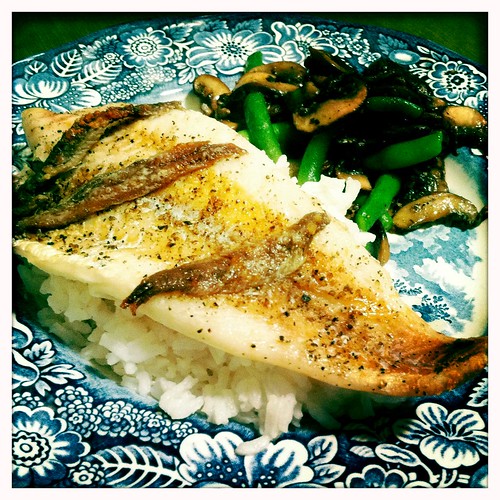
This recipe is from the "17th-Century England" chapter in Esther B. Aresty's The Delectable Past, which was recommended to me by Susan at The Well-Seasoned Cook. As usual, I've used cheap, domestic, sustainable Pollock. I've gotten to the point where I almost always have some in the freezer. It defrosts quickly and cooks quickly, which is perfect. Once thawed, this dish only takes about 10 minutes of cooking. I served it with rice and sautéed mushrooms and green beans (I grew the green beans myself!).
Labels:
17th century,
British,
music,
opera,
way back wednesday
Wednesday, October 26, 2011
Guest Post at Nifty Thrifty Things
Vanessa at Nifty Thrifty Things is going to be in Houston for an extended visit and asked her readers to help keep her blog going while she's out of town. I'm really happy to have today's guest post--it's all about three upcoming holidays: Halloween, Guy Fawkes Day/Bonfire Night and Stir-up Sunday. Please stop by and check it out!
Also, we've got this week's Baroque music:
Barbara Strozzi
"Sino alla morte"(couldn't find the recommended piece, but this one's lovely)
Scarlatti
"Correa nel seno amato"
Purcell
"From Rosy Bowers"
"The Plaint"
Week 1, Week 2, Week 3, Week 4
Labels:
17th century,
British,
feasts and festivals,
music,
opera,
traditional food
Wednesday, October 19, 2011
North by Northwest Guest Post and More Baroque Music
Exciting news! I've written a North By Northwest, 20th Century Limited Dining Car-inspired menu for Andrea's blog, Paper Sparrow. Please stop by and check out the Hitchcock Blog Party.
Labels:
17th century,
1950s,
dinner and a movie,
movies,
music,
opera,
vintage
Wednesday, October 12, 2011
Black (and White Wednesday) Treacle and Baroque Music
Why oh why is black treacle so difficult to find? I believe it's almost identical to blackstrap molasses, but I'm partial to Lyle's and I love its jaunty red tin. I've never seen it in Wichita period (even at World Market) and I used to buy it at Canterbury British Imports in Oklahoma City, but it looked like they'd gone out of business the last time I drove by. Plus, it's expensive on the internet due to shipping costs. Anyone know of a reliable source?
Black Treacle is awesome stuff--it looks like crude oil and tastes like a more-metallic molasses. That's probably totally unappealing but I love it in its unappealingness. It's also rich in vitamins, minerals and iron. It's practically a health food! Not that what I normally do with it is particularly healthful--
Wednesday, October 5, 2011
Way Back Wednesday: Forks are for Fricassées
Clockwise from top: Fricassée close-up, Fricassée served with a green salad and chardonnay, vegetables cooking, parsley from my garden
Thomas Coryate brought the fork from Italy to England in 1608. At first, they were rejected as "effeminate" and "unnecessary," but the wealthy soon adopted them as a status symbol, buying forks made with expensive materials to impress their guests.* The fricassée, a French invention that became popular in England, was tailor-made for these newly fashionable forks. Neither knives nor spoons are required, meaning that cooking fricassées encouraged using forks and vice versa.**
Labels:
17th century,
music,
opera,
way back wednesday
Wednesday, September 28, 2011
Way Back Wednesday: Spiced Pears with Cream
In The Cook's Guide (1664), Hannah Woolley gives instructions "To stew Pippins with cream:"
Take your Pippins, pare them and core them; if you would have them red, bake them first, or else put to them as much water as will cover them and some cinnamon and cloves unbeaten; turn them sometimes and cover them close; set them over the fire till they begin to be tender, then sweeten them with sugar; and boile them when the sugar is in till they are clear, then put sweet cream to them, and let them stew together till you find they be enough; thus you may do with baked pears (58-59).
I decided that baking the pears in a spiced sugar syrup and then pouring the cream over would give better results after attempting to follow Hannah Woolley's instructions, which ended in curdled cream, which wasn't terribly attractive. However, the pears were so tasty I thought it worth my time to rework the recipe:
Friday, September 23, 2011
Feasts and Festivals: Harvest Home
Harvest Home falls on the first day of autumn every year. To celebrate, I made a seasonal treat--Blackberry and Apple Tray Bake. It's baked in a 9"x13" pan, until the apples and blackberries are soft and juicy and the dough is just set but still a bit gooey. What better way to celebrate the bounty of the earth?
In pre-industrial Britain, Harvest Home celebrated the end of the cereal harvest (wheat, oats, barley or rye). This harvest was the most concentrated period of labor for agricultural workers* and, in a pre-industrial society, almost everyone had deep-rooted ties to the land, from peasants to tenant-farmers, to great landlords. It was a society tuned in to the minute details of seasonality.
Labels:
17th century,
British,
feasts and festivals
Subscribe to:
Posts (Atom)